What dropshipping is, and what it isn't
This lesson explains what dropshipping actually is, in plain words, before you spend a single dollar.
You will learn how an order moves from your store to your customer's door, what you are responsible for, and what you are not. You will also see the three main ways people dropship in 2026.
Getting this right matters. Most beginners who lose money don't lose it because the idea was bad. They lose it because they misunderstood the model and counted only part of their costs.
The big idea
Dropshipping is a retail model where you sell a product before you own it.
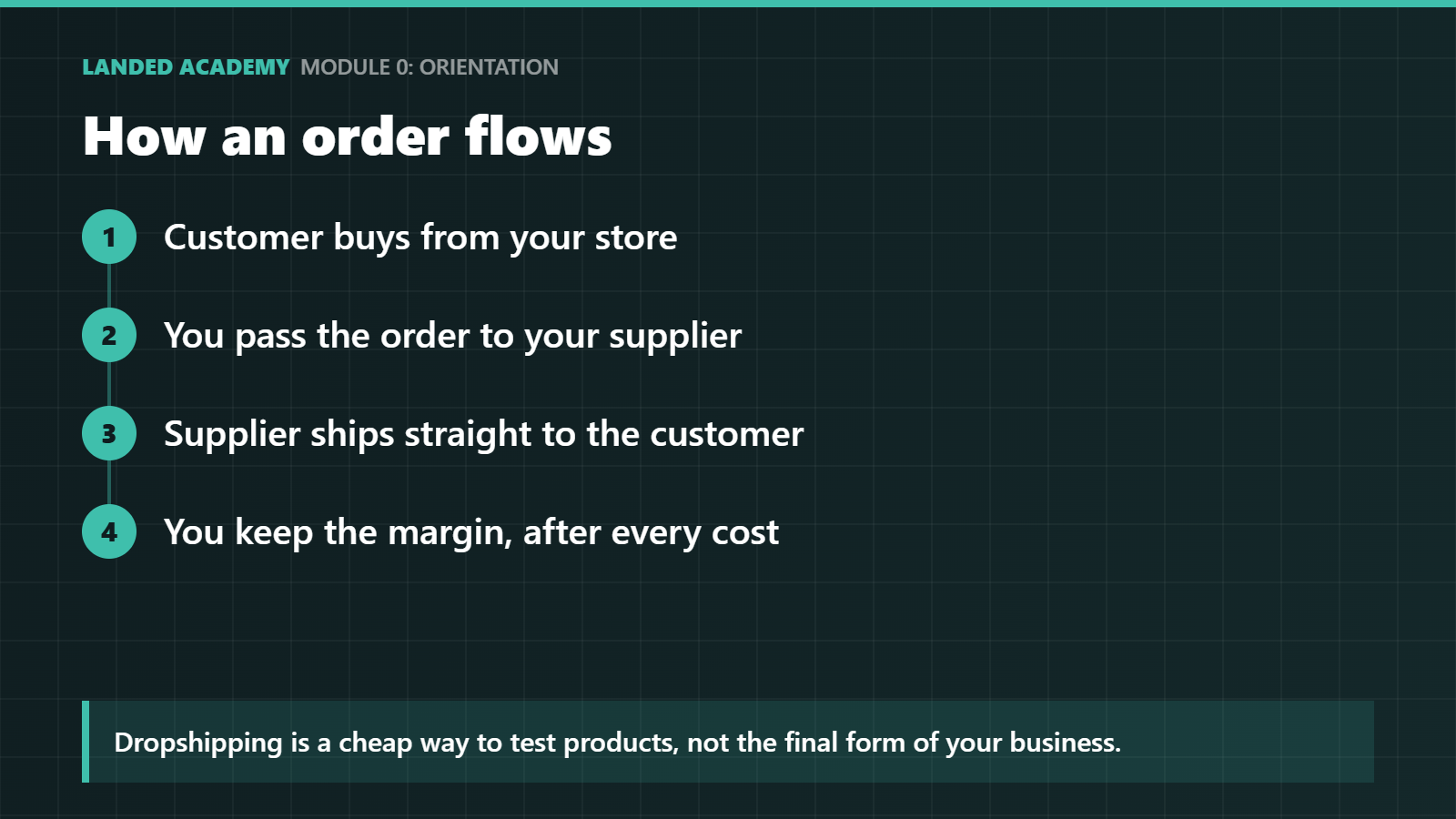
A customer buys from your store. You pass the order and their address to a supplier. The supplier ships the product directly to the customer. You keep the difference between what the customer paid and what everything cost you.
Here is an everyday way to picture it. Imagine you run a small travel agency. You don't own the hotel or the plane. You find the customer, sell them the trip, and book it with the companies that deliver it. If the hotel is dirty, though, the customer calls you, not the hotel.
Dropshipping works the same way. You are the shop window and the person the customer trusts. The supplier is the warehouse behind the curtain.
“If you're not embarrassed by the first version of your product, you've launched too late.”
Reid Hoffman, Co-founder of LinkedIn
Why "everything" is the most important word
That phrase, "what everything cost you," is where most beginners go wrong.
The product's wholesale price (the price your supplier charges you for one unit) is only one line. You also pay for:
Shipping: getting the parcel to the customer.
Duties: taxes charged when goods cross a border into a country.
Payment processing: the small cut the payment company takes from each sale.
Apps: monthly tools that run parts of your store.
Refunds: money you give back when orders go wrong.
Advertising: what it cost to bring in the customer who bought.
A product you buy for $8 and sell for $30 can easily lose money once all of these are added up. You will see exactly how in the example below.
What you own, and what you don't
As a dropshipper, you own three things:
The customer relationship. Your store, your emails, your support inbox.
The marketing. You are responsible for every visitor who arrives.
The risk. If the supplier ships late or sends junk, the customer blames you, and the chargeback lands on your account. A chargeback is when a customer asks their bank or card company to reverse a payment, and the money is pulled back from you.
You do not own inventory, warehouse space, or packing. That's the appeal, and also the weakness: you have limited control over quality and speed.
Think of dropshipping as a way to test products cheaply, not as the final form of your business. The stores that last usually move their best sellers into held inventory or a private-label brand once demand is proven. Module 11 covers that step.
Private label means a product made for you and sold under your own brand name, rather than a generic item many stores sell.
The three ways people dropship in 2026
Own store: a Shopify (or similar) store, with traffic from ads and content. Best for building a brand you control.
Marketplace: TikTok Shop, Amazon, or eBay listings fulfilled by a supplier. Best for using built-in traffic, with strict rules.
Hybrid: your own store plus marketplace channels, all from the same supplier. Best for diversifying once one channel works.
You don't need to pick forever. You only need to pick a starting point.
Example: Sam's $8 water bottle
This is a made-up example with hypothetical numbers. Real costs vary.
Say Sam finds a pet water bottle for $8 and sells it for $30. It looks like $22 profit. Here is what one order really costs Sam:
Product: $8.00
Shipping to the customer: $5.00
Duties built into the supplier's price: $1.50
Payment processing (say 3% of $30): $0.90
App costs spread across orders: $1.00
Refund allowance (money set aside for returns): $1.50
Ad spend needed to get this one sale: $16.00
Add them up step by step: $8.00 + $5.00 = $13.00. Plus $1.50 = $14.50. Plus $0.90 = $15.40. Plus $1.00 = $16.40. Plus $1.50 = $17.90. Plus $16.00 = $33.90.
Sam takes in $30.00 and spends $33.90. That's a loss of $3.90 per order. The more Sam sells, the more Sam loses.
This isn't meant to scare you. It shows why you will learn to count every cost before you sell.
Step by step
Write one sentence, in your own words, describing how a dropshipping order moves from customer to supplier to doorstep.
Copy the list of costs above (product, shipping, duties, processing, apps, refunds, ads) into a notebook or spreadsheet.
Pick any product you've seen online and guess a number for each cost line.
Add the lines up and compare the total with the selling price.
Write down the three things you own as a dropshipper, and one way you could reduce each risk.
Choose which of the three models (own store, marketplace, hybrid) feels like the right starting point for you.
Common mistakes
Counting only the product price. Fix: always total every cost line, including ads and refunds, before calling something profitable.
Thinking the supplier carries the risk. Fix: plan for late or broken orders yourself, because the customer and the chargeback come to you.
Treating dropshipping as the final business. Fix: see it as a cheap way to test demand, then plan to hold stock or build a brand around winners.
Trying all three models at once. Fix: start with one, and add a second channel only after the first works.
Remember
Dropshipping means selling first, then having a supplier ship directly to your customer.
Profit is what's left after every cost, not just the product price.
You own the customer, the marketing, and the risk, so choose suppliers carefully.