Types of suppliers
In this lesson you'll learn about the four main kinds of suppliers a dropshipping store can work with, and what each one is good and bad at.
Your supplier is the business that holds the stock, packs the box and sends it to your customer. You never touch the product, so the supplier decides most of what your customer actually feels: how fast the order arrives, what the box looks like and whether the product is any good.
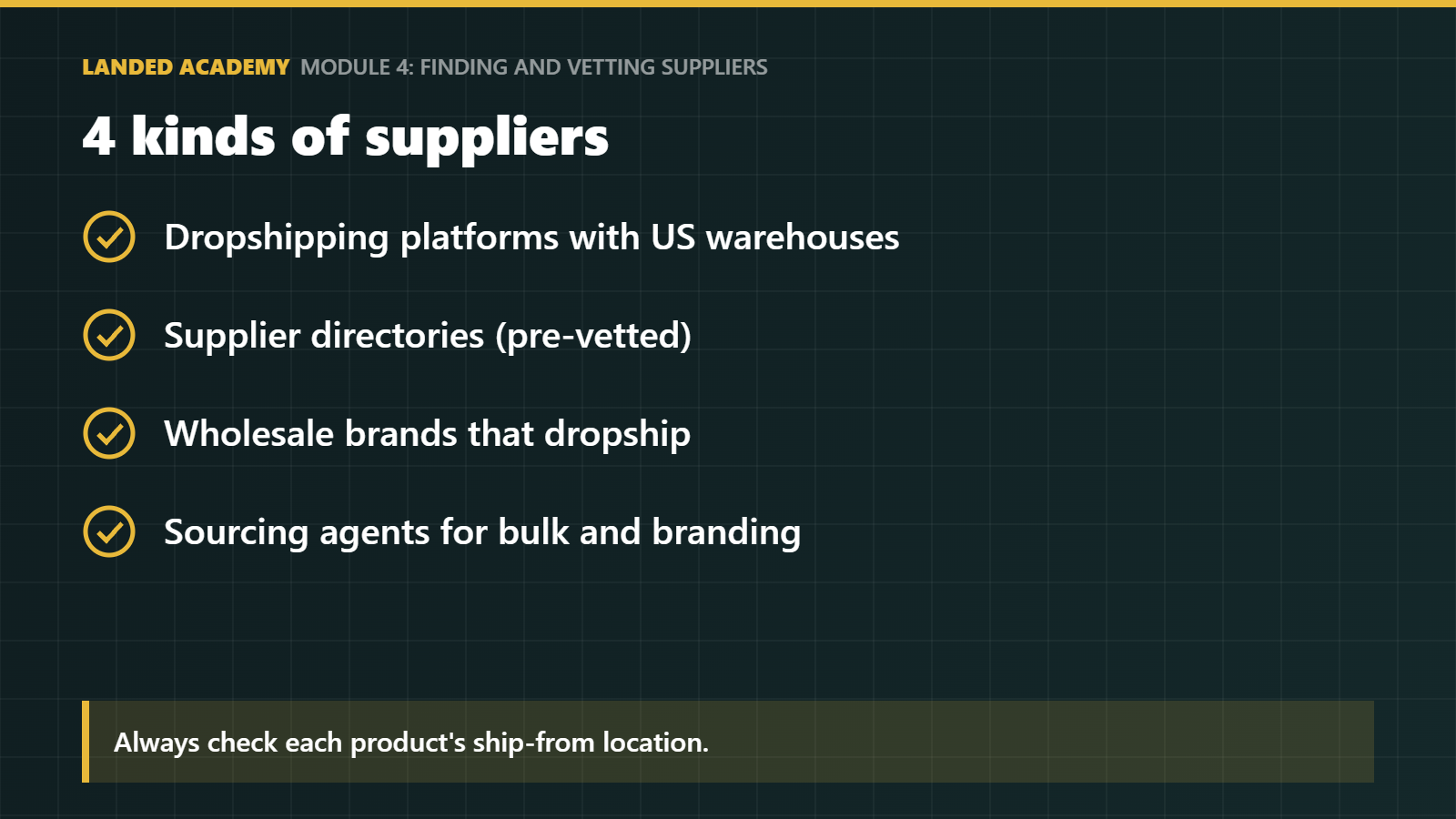
Picking the right type of supplier first saves you weeks of trial and error later.
The big idea
Think of suppliers like ways of getting dinner. A food delivery app gives you lots of choice with very little effort. A trusted local restaurant gives you better quality, but you have to call them yourself. A personal chef can make exactly what you want, but you need to know what you're asking for.
None of these is "best". Each one trades off ease, quality, speed and control. Your job is to pick the type that fits where your store is right now.
Here's the key term for this lesson: ship-from location means the place a parcel actually leaves from. A product shipping from a warehouse in your customer's own country usually arrives faster and avoids surprise import charges.
“We are stubborn on vision. We are flexible on details.”
Jeff Bezos, Founder of Amazon
Dropshipping platforms and supplier directories
Dropshipping platforms with US warehouses are apps that plug into your store and send orders to suppliers automatically. Examples: CJdropshipping, Zendrop, Spocket, AutoDS.
Strength: easy store integrations, meaning they connect to your store in a few clicks. They offer a mix of domestic and overseas stock.
Watch out for: not every product is in a US warehouse. Filter for US stock, and check each product's ship-from location before you add it.
Supplier directories are lists of suppliers that someone has already checked. Examples: SaleHoo, Syncee and others.
Strength: pre-vetted suppliers, which means the directory has screened them first. Many are based in the US and EU.
Watch out for: subscription fees, which you pay every month or year. Pre-vetted does not mean perfect, so still sample everything.
Wholesale brands and sourcing agents
Wholesale brands that dropship are real brands that will ship their own products to your customers. You usually find them by contacting brands directly, by email or through their website.
Strength: quality, real brand products and sometimes exclusivity, meaning you might be one of only a few stores allowed to sell them.
Watch out for: a minimum order or an approval step. Some brands want to see your store before they say yes.
Sourcing agents are independent people or small companies based in manufacturing countries. They find factories, check goods and organize shipping for you.
Strength: custom packaging and bulk shipments to US warehouses, so you can ship fast once you have steady sales.
Watch out for: weak paperwork at the border. Choose an agent with strong customs and compliance experience. Customs is the government check on goods entering a country, and compliance means following the safety and import rules.
A word about changing tools
Tools and companies change. Treat this list as starting points, not recommendations.
Before you sign up for anything, check current reviews, fees and shipping options. A platform that was great last year may have changed its prices or warehouses since.
Example: matching a supplier type to a beginner
This is a made-up example. Say Jordan is starting a store selling pet travel accessories to US customers. Jordan has a small budget and no sales yet.
Jordan compares two options for the same dog seat cover:
Option A: a dropshipping platform listing shipped from overseas. Product cost $11, delivery estimate 12 days.
Option B: the same type of item from a US warehouse on the same platform. Product cost $13, delivery estimate 4 days.
Option B costs $13 − $11 = $2 more per order. If Jordan sold 50 orders in a month, that's 50 × $2 = $100 extra in product costs.
But a 12-day wait leads to more "where is my order?" messages and more refunds. If even 3 of those 50 orders turned into refunds on a $35 product, that's 3 × $35 = $105 lost, which already wipes out the saving.
So Jordan starts with Option B. Later, if one product sells steadily, Jordan can look at a sourcing agent for bulk stock in a US warehouse.
Step by step
Write down the country you sell to. Every supplier decision starts with where your customers live.
Pick one or two dropshipping platforms and turn on the filter for warehouses in that country.
For each product you like, open the listing and note the ship-from location and the delivery estimate.
Look at one supplier directory and compare its subscription fee with how many relevant suppliers it lists in your niche.
Search for two or three brands in your niche and check their website for a "wholesale" or "retailers" page.
Read recent reviews of any tool before you pay for it, and look for comments about shipping times.
Put everything in one simple list: supplier, type, ship-from location, fees, notes.
Common mistakes
Assuming "US warehouse" applies to the whole catalog. Fix: check the ship-from location on every single product, not just the supplier's homepage.
Paying for a directory and skipping samples. Fix: treat pre-vetted as a shortlist, then order samples anyway.
Never contacting brands because it feels scary. Fix: send a short, polite email. The worst answer is "no".
Hiring the cheapest sourcing agent. Fix: ask about their customs and compliance experience before you talk about price.
Trusting an old list of tools. Fix: check current reviews, fees and shipping options before signing up.
Remember
Each supplier type trades off ease, quality, speed and control.
Always check the ship-from location for each product, not each supplier.
Tools change, so verify current fees and reviews before you sign up.