TikTok Shop
TikTok Shop lets people buy directly inside the TikTok app. A shopper can watch a video, a live stream, or a post from a creator, tap the product, and check out without ever leaving the app.
It is one of the biggest opportunities for product sellers in 2026. It is also one of the strictest places to sell, with clear rules about who can sell and how fast orders must ship.
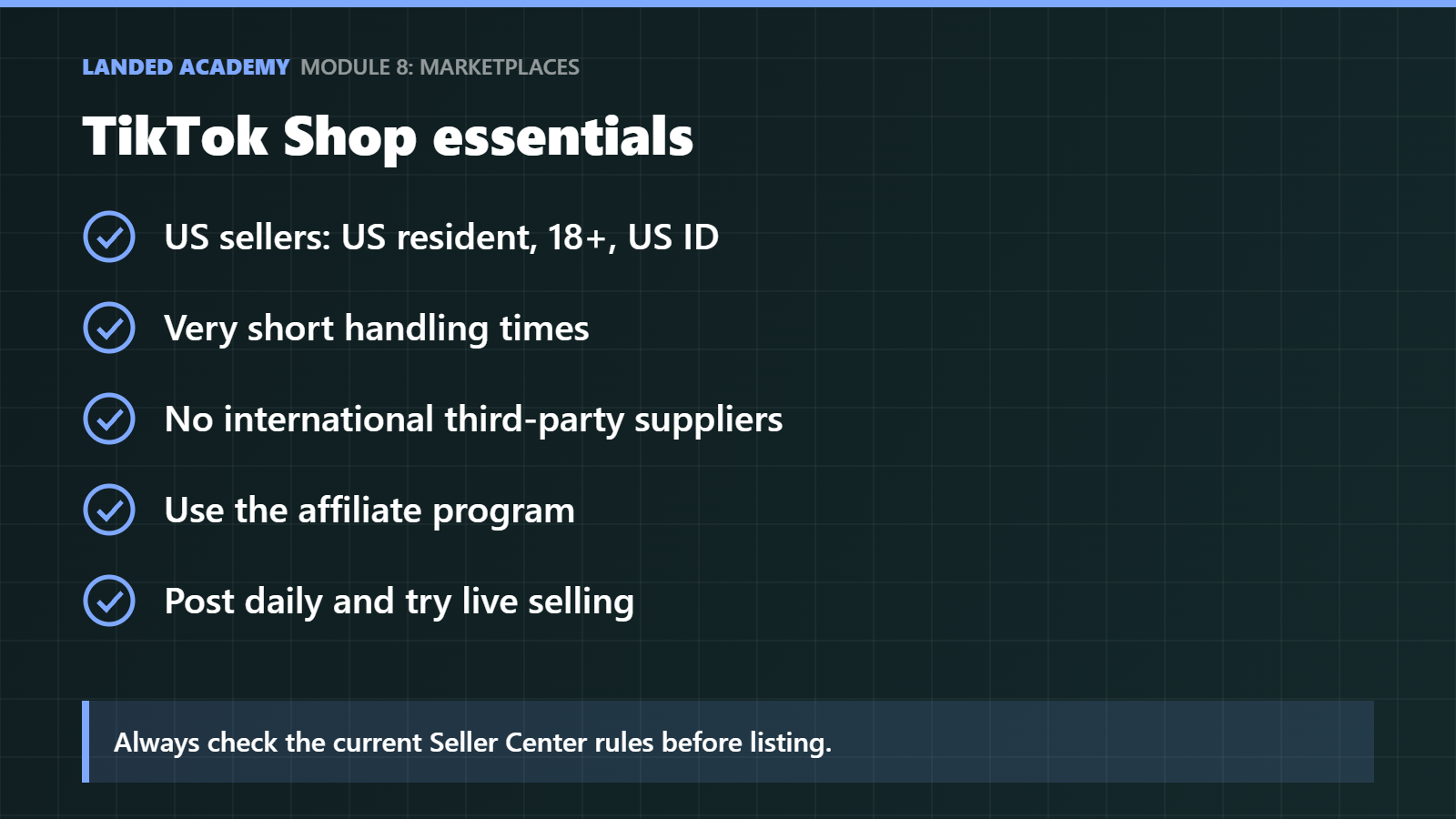
In this lesson you will learn what TikTok Shop checks before and after you join, how to make sure your supplier can keep up, and the three habits that help products sell there.
The big idea
Think of TikTok Shop as a busy street market inside a giant entertainment hall. Millions of people walk past your stall every day, but they came to be entertained, not to shop.
That means two things. First, your product has to show up inside the entertainment, in videos and live streams. Second, the market managers watch every stall closely. If you are slow to hand over goods, they notice, and they can close your stall.
So success on TikTok Shop rests on two legs: content that puts your product in front of people, and operations that deliver fast and reliably.
“If you're not embarrassed by the first version of your product, you've launched too late.”
Reid Hoffman, Co-founder of LinkedIn
What to know before you apply
Read these points before you open an account. Each one can stop you from selling if you skip it.
Who can sell. For TikTok Shop US, individual sellers generally must be US residents, at least 18 years old, with valid US ID.
Handling time. Handling time means how long you take between receiving an order and handing it to the carrier. TikTok Shop's handling-time requirements are short.
Late dispatch rate. This is the share of your orders that ship later than allowed. TikTok Shop monitors it. Your supplier must ship fast and upload tracking quickly, because a tracking number is how the platform knows a parcel is on its way.
Where products ship from. Fulfillment means the work of packing and shipping an order. Fulfillment guidance for US-based sellers prohibits using international third-party suppliers or consolidation services (companies that gather items from several overseas suppliers and ship them together). In practice, use suppliers with US stock, meaning products already sitting in a US warehouse.
Supplier integration. Some suppliers integrate directly with TikTok Shop, so orders flow to them and tracking numbers flow back automatically. Confirm this works before you list a product, not after your first sale.
Fees and rules change. Fees and rules differ by product category and region, and they get updated. Always check the current policies in TikTok Shop's Seller Center rather than relying on old videos or blog posts.
How to win on TikTok Shop
1. Open your product to the affiliate program. An affiliate is a creator who promotes your product and earns a commission, which is a percentage of each sale they bring in. Set a competitive commission so creators choose your product over others.
2. Post your own videos daily with the product tagged. Tagging links the video to your product so viewers can buy with a tap. Daily posting gives the app many chances to show your product to the right people.
3. Try live selling once you have a few products. Live selling means streaming in real time, showing products and answering questions while people buy. It works better once you have a few products.
Example: Maya checks her numbers before listing
This is a made-up example with hypothetical numbers, just to show the thinking.
Say Maya wants to sell a desk cable organizer on TikTok Shop for $24.00. Her US-based supplier charges $9.00 for the product and $4.00 for shipping.
Product plus shipping: $9.00 + $4.00 = $13.00.
She offers creators a 15% affiliate commission: $24.00 × 0.15 = $3.60.
For this example, suppose platform fees come to $2.00 per order. (Maya would look up the real fee for her category in Seller Center.)
Total cost per order: $13.00 + $3.60 + $2.00 = $18.60.
Money left per order: $24.00 − $18.60 = $5.40.
Maya has room for the commission. She lists only after confirming her supplier's shipping and tracking speed fit TikTok Shop's handling-time rules.
Step by step
Open TikTok Shop's Seller Center and read the current eligibility rules. Confirm you meet them.
Write down your supplier's typical handling time and how fast they upload tracking. Ask them directly if you are not sure.
Confirm your supplier ships from US stock, not from overseas or through a consolidation service.
Check whether your supplier integrates with TikTok Shop for order and tracking sync. Test it with one order if you can.
Look up the current fees for your product's category and work out your money left per order, like Maya did.
Decide on an affiliate commission that still leaves you a profit.
Plan your first seven days of videos, one per day, each with the product tagged.
Common mistakes
Using an overseas supplier. This goes against the fulfillment guidance for US-based sellers. Fix: switch to a supplier with US stock before you list.
Ignoring the late dispatch rate. Slow shipping is tracked and can hurt your account. Fix: check unfulfilled orders every day and chase your supplier quickly.
Setting a commission too low to attract creators. Creators pick products that pay them fairly. Fix: run the numbers, then offer the best commission you can afford.
Trusting old fee information. Fees and rules change by category and region. Fix: check Seller Center before every new product.
Jumping into live selling with one product. It is hard to fill a stream with a single item. Fix: start with daily videos and go live once you have a few products.
Remember
TikTok Shop rewards both good content and fast, reliable shipping.
Use US-stock suppliers who ship fast and upload tracking quickly.
Affiliates, daily tagged videos, and later live selling drive sales.